
Emerging Climate Champions
Youth Sustainability Summit
Explore. Learn. Collaborate. Lead.
A Georgia Tech SCoRE site visit and community engagement workshop at Cascade Springs Nature Preserve. Participants will explore community conditions, role-play stakeholder perspectives, and create recommendations for the Atlanta Nature Center.
ThursdayJune 25, 2026
4:00 PM – 5:30 PMWorkshop and site visit
Cascade Springs Nature Preserve2852 Cascade Road SW, Atlanta, GA 30311
Workshop Process
This page is a participant workspace. Use it to review the summit materials, understand the engagement process, and complete the two workshop surveys.
1
Inform
Review community conditions, assets, challenges, and project background.
2
Consult
Confirm your understanding and provide feedback on what was presented.
3
Involve
Work within one of the four sustainability committees.
4
Collaborate
Work through community circles and consider different stakeholder perspectives.
5
Empower
Create recommendations for Atlanta Nature Center programming aligned with the Mayor’s Four Pillars.
Community Information & Workshop Resources
Review these materials before completing Survey #1. These resources provide the background participants need before creating recommendations.
Case Study
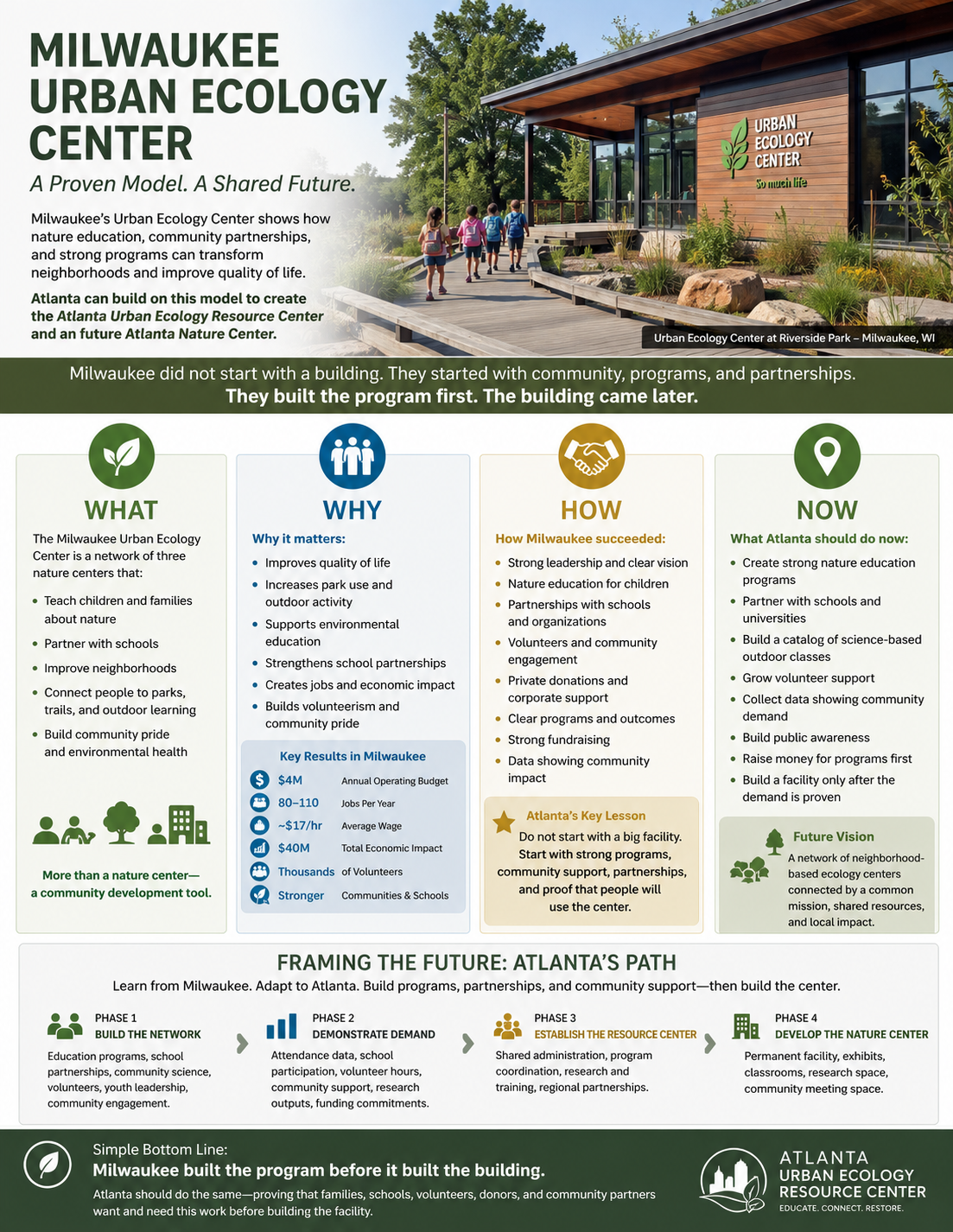
Urban Ecology Center Model
Learn how the Milwaukee Urban Ecology Center combines environmental education, neighborhood partnerships, outdoor recreation, and community stewardship.
View SummaryVision
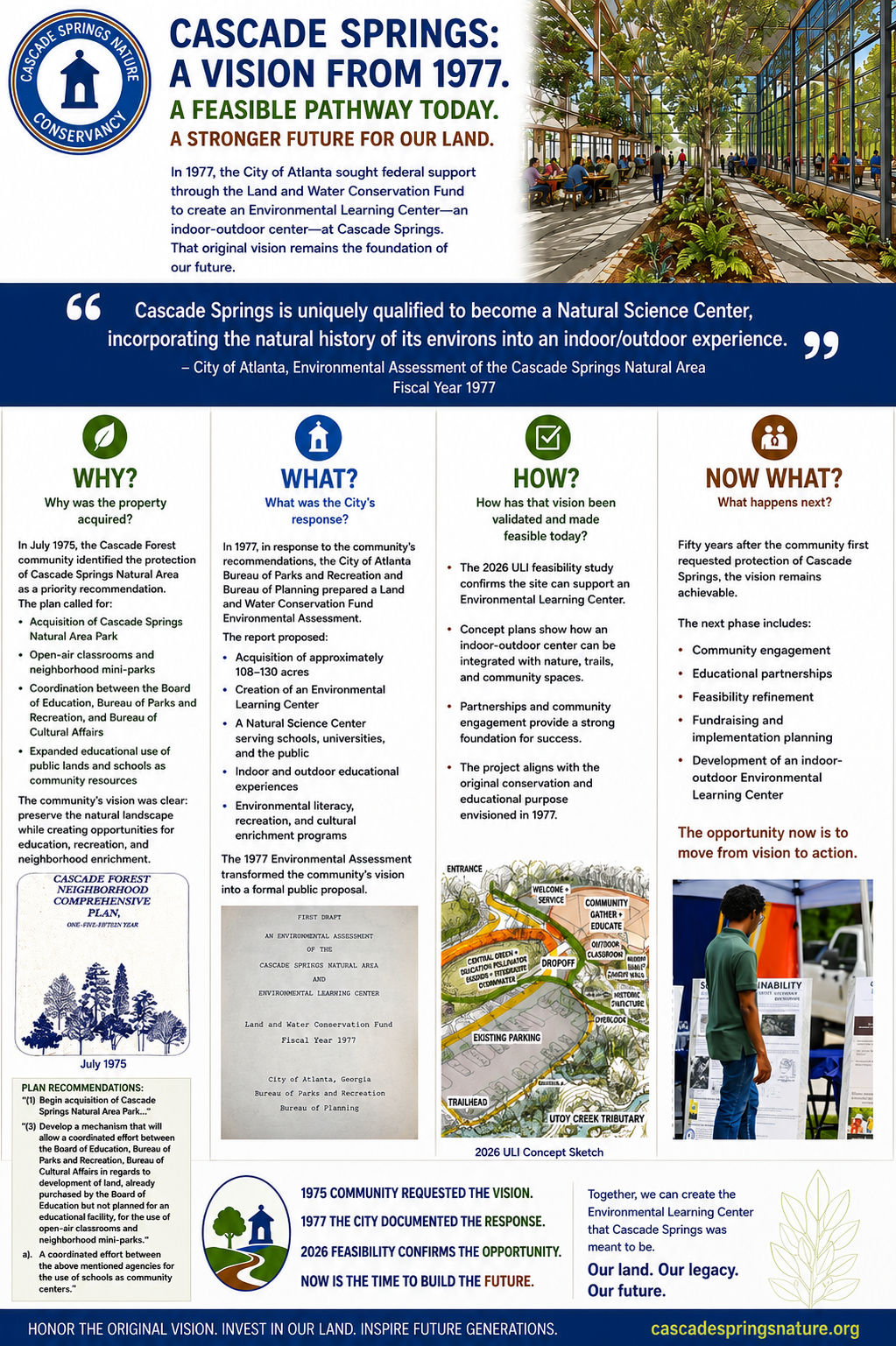
Atlanta Nature Center
Review the vision for an indoor-outdoor natural science center supporting education, research, community engagement, and urban forest stewardship.
View OverviewUrban Forest
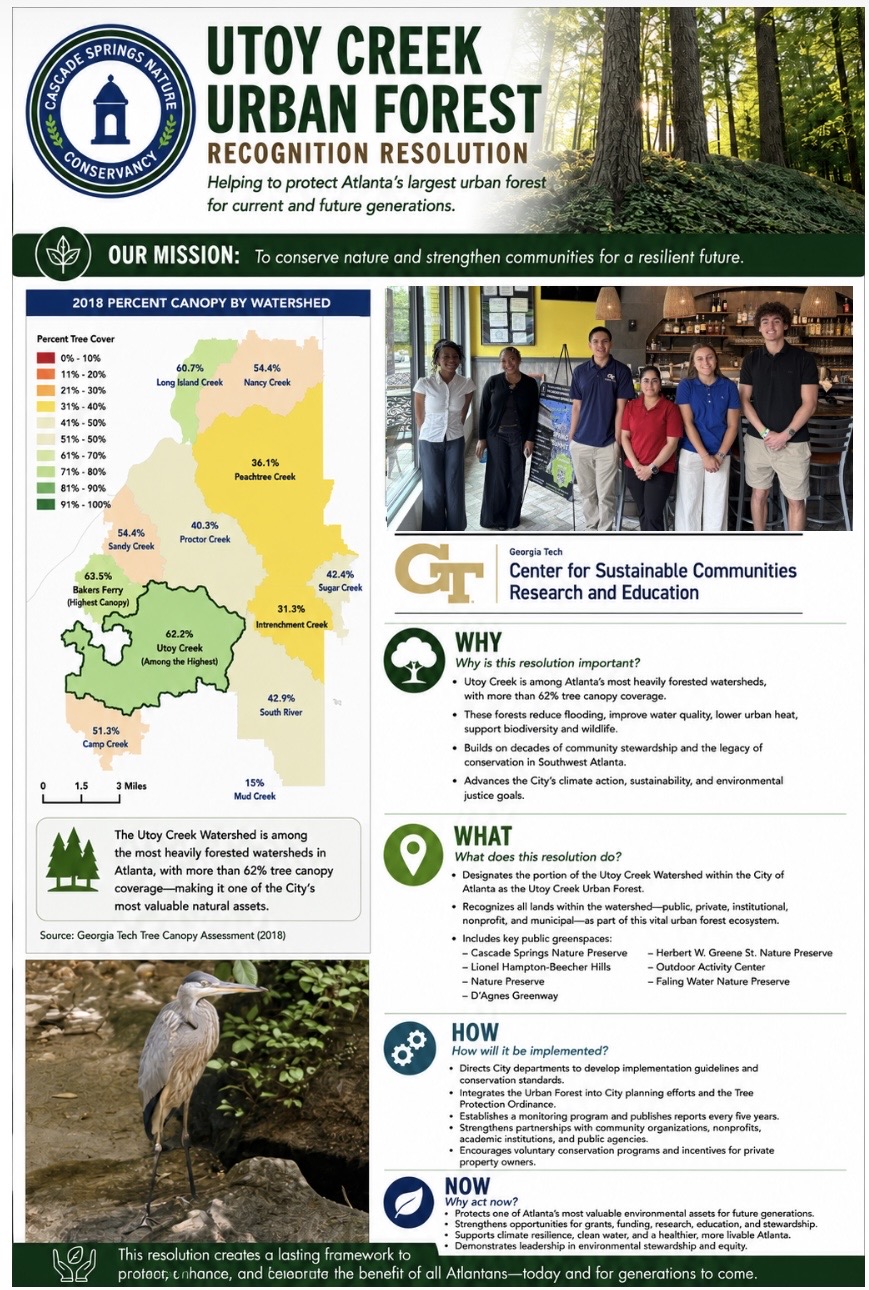
Utoy Creek Urban Forest
Understand the watershed, canopy, conservation, and policy context for one of Atlanta’s most important urban forest systems.
View OverviewSite Conditions
Community Conditions
Review maps, site observations, access issues, trails, hydrology, canopy conditions, and neighborhood opportunities around Cascade Springs Nature Preserve.
View ConditionsPlanning Lens
Mayor’s Four Pillars
Use the Mayor’s priorities as a civic framework for recommendations: safety, opportunity, future-focused infrastructure, and ethical government.
View PillarsSimulation
Stakeholder Roles
Review how stakeholder roles will be organized within five community circles: government, community, educational partners, businesses, and youth.
View Community CirclesFour Sustainability Committees
Participants will work through one of these lenses to evaluate needs, opportunities, and recommendations.
Human Sustainability
Health, education, recreation, safety, wellness, and quality of life.
Social Sustainability
Community connection, culture, equity, trust, civic participation, and belonging.
Environmental Sustainability
Urban forests, biodiversity, microclimates, climate resilience, water quality, conservation, and stewardship.
Economic Sustainability
Workforce development, local investment, tourism, partnerships, and long-term value.
Five Community Circles
Participants will organize into five community circles. The stakeholder categories below are distributed across the circles for the role-play simulation.
Government
- Elected Officials
- Environmental Regulatory Groups
- Transportation Authorities
- Utility Companies
Community
- Local Residents
- Community Groups
- Environmental Advocacy Groups
- Non-Profit Organizations
- Cultural & Historical Societies
- Religious Institutions
Educational Partners
- Educational Institutions
- Urban Planners / Architects / Engineers
Businesses
- Businesses
- Tourism Boards
- Media Outlets
Youth
Young people ages 15–35.
Complete the Two Workshop Surveys
The first survey confirms understanding. The second survey documents recommendations.
Survey 1: Confirm Understanding
Complete this after reviewing the boards and workshop materials.
- Sustainability framework
- Stakeholder roles
- Community conditions
- Urban Ecology Center model
- Mayor’s four pillars
Survey 2: Submit Recommendations
Complete this after committee discussion and community circle role-play.
- Committee recommendations
- Community circle priorities
- Nature Center ideas
- Alignment with sustainability pillars
- Alignment with Mayor’s pillars
Recommendation Framework
Survey #2 asks participants to turn workshop learning into recommendations for the Atlanta Nature Center.
How Recommendations Are Created
Participants will use the Urban Ecology Center report and summary recommendations to imagine programming for the Atlanta Nature Center. They will combine that model with what they learned from the community information boards, their community circle discussion, and the four sustainability committees.
Each recommendation should explain what the Nature Center could do, who it would serve, which sustainability committee it supports, and how it aligns with the Mayor’s Four Pillars.
Workshop Outputs
- Nature Center program ideas
- Recommendations from each sustainability committee
- Community circle perspectives
- Youth leadership insights
- Alignment with the Mayor’s Four Pillars
- Inputs for the Community Participation Plan
Aligning With the Mayor’s Four Pillars
Recommendations should connect to at least one citywide priority.
One Safe City
Building safer neighborhoods for all who live, work, and visit.
Opportunity for All
Expanding access, opportunity, local investment, and pathways for every Atlantan.
A City Built for the Future
Investing in resilient infrastructure, innovation, climate readiness, and future generations.
Effective & Ethical Government
Delivering accountable, transparent, and efficient public service.
Workshop Resource Library
These resource boards are included directly on this page so participants can review them without leaving the summit workspace.

Survey Results Summary
Review the summit survey summaries: Survey #1 established shared understanding, and Survey #2 documents youth recommendations for the future.
Survey #1: Establishing a Shared Understanding

Survey #2: Youth Recommendations for the Future
