
Under construction: these sections are growing as we gather our work into them. Check back soon.
Recognize: establish the ecological core
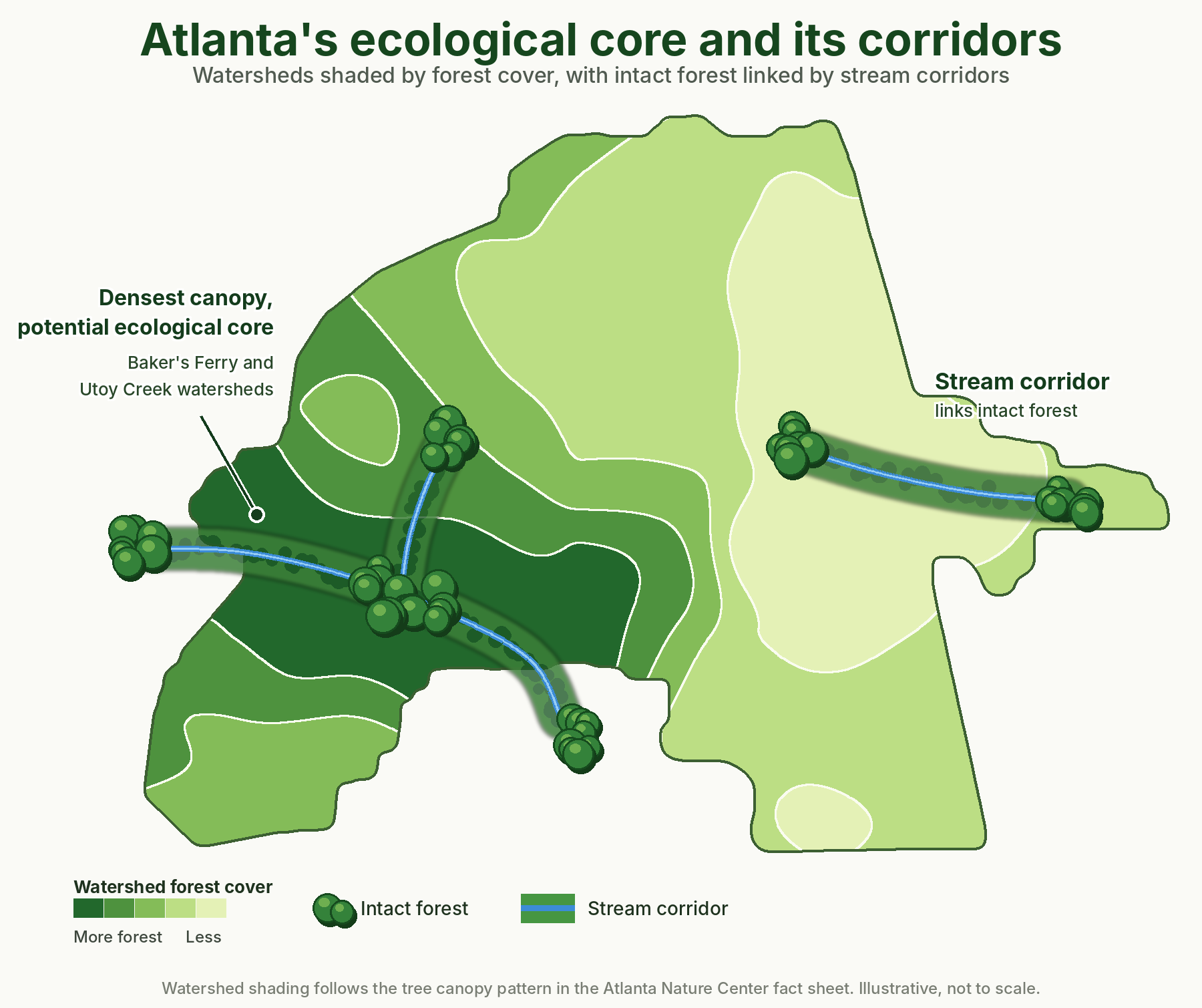
An ecological core is the most intact, connected and forested part of a landscape: the heart that keeps the wider system healthy. In Atlanta, the darkest green on the map marks the Baker's Ferry and Utoy Creek watersheds, side by side in southwest Atlanta. Together they hold the city's densest tree canopy, with Baker's Ferry first and Utoy Creek second, which makes them Atlanta's potential ecological core. Our research is now testing that.
A core doesn't stand alone. Stream corridors, ribbons of water flanked by trees, link intact forest inside the core to forest beyond it. They let wildlife move, keep water clean and spread the forest's benefits across the city. The streams on the map are illustrative while we map the real corridors.
Recognizing the core means documenting it, naming it and giving it standing:
- Tree canopy assessment: Georgia Tech's tree canopy assessment documented where Atlanta's canopy is densest, helping define the ecological core.
- Legislation: Atlanta City Council designated the Utoy Creek Urban Forest (Resolution 26-R-3664, adopted June 15, 2026).
- Planning: earlier work with the Atlanta Regional Commission on transportation routes through the core.
More coming soon.
Measure: document the benefits
Measuring the forest turns its value into evidence, and it's how we will confirm the ecological core. Scientists call these benefits ecosystem services: cooling, cleaner air, stormwater control, carbon storage and habitat. We measure them in several ways:
- Microclimates: a network of sensors tracks temperature, humidity and air pollutants across the Utoy Creek watershed.
- Birds: bird counts and sightings logged on eBird show which species depend on the forest.
- Biodiversity: community events such as iNaturalist bioblitzes record the plants, insects and animals living here.
- Trees: tree inventories record species, size and health, and estimate carbon and air benefits.
- Streams: water quality and stream health monitoring show how the forest protects our waterways.
More coming soon.
Protect: build lasting stewardship
Protecting the ecological core means keeping it healthy for generations, and the best protection is people who care for it. Ways we protect the forest:
- Removing invasive plants: clearing English ivy, privet and kudzu so native trees and plants can thrive.
- Guarding against development: advocating for land conservation, easements and policies that keep forest standing.
- Planting and restoring: planting native trees and restoring stream banks to reduce erosion.
- Training stewards: engaging youth, students and neighbors through Restoration Day, youth summits and hands-on learning.
- Building partnerships: working with Georgia Tech, the City of Atlanta and community partners to care for the core together.
More coming soon.