
Home » Forum
Manufacturing technology for Submerged Entry Nozzle

Quote from hyrefractory on December 16, 2025, 9:48 amThe Submerged Entry Nozzle (used for the nozzle between the tundish and the mold), the long nozzle (used for the nozzle between the ladle and the tundish) and the sliding nozzle are called the “three major pieces” of refractory materials for continuous casting. Refractory materials used in the final stage of the steelmaking process. They are different from other refractory materials in that they are mostly used as their own single components.
In the early stages of the introduction of the continuous casting method, fused quartz nozzles were used as continuous casting nozzle bricks based on the requirement of thermal shock resistance and the ability to be used without preheating. However, it has the disadvantage of extremely poor durability for steel types with high Mn content. Due to the development of steelmaking technology, which requires multi-furnace continuous casting and the production of clean steel, there is an urgent need to improve the durability of the nozzle. For this purpose, the highly durable Al2O3-C nozzle (AG quality nozzle) was developed and is still used as a mainstream nozzle brick to this day.
Continuous casting requirements for Al2O3-C Submerged Entry Nozzle In order to withstand the operating conditions of continuous casting steel, Al2O3-C (AG) quality refractory materials should have:
(1) It has good resistance to mold slag.
(2) It has excellent thermal shock resistance and can withstand severe thermal shock conditions at the beginning of steel casting.
(3) It has good corrosion resistance to molten steel.
(4) It has better resistance to oxidation and weakening during preheating and actual operation.
(5) Has sufficient mechanical strength.
Therefore, today, graphite and alumina are used as raw materials, phenolic resin is used as a binder, and antioxidants are added, followed by mixing, isostatic pressing (CIP) molding and firing, and mechanical processing to make long nozzles, integral stoppers and rods. Submerged Entry Nozzle.
This molding (CIP) method achieves the requirements of uniform internal structure and stable quality for large overall products.
For the Submerged Entry Nozzle, the lower part (the part in contact with the mold slag during actual operation) is usually covered with zirconium graphite (ZG) refractory material that has good resistance to the mold slag.
The development of continuous cast refractory products has introduced the isostatic pressing (CIP) molding process into the manufacturing of refractory materials. This is because:
(1) The length/diameter ratio of long nozzle bricks, immersed nozzle bricks and integral stopper rods is too large and cannot be pressed with ordinary double-sided hydraulic presses. Only by using isostatic pressure (CIP) can the pressure on the pressing surface be uniform. The volume density of each section of the brick is uniform.
(2) Isostatic pressing (CIP) can press corundum-graphite mud with high graphite content that is difficult to press and has low binder content and poor plasticity.
(3) Since long nozzle bricks, immersed nozzle bricks and integral plug rods are made of corundum-graphite material with high graphite content, only isostatic pressing (CIP) molding can avoid brick cracks and ensure brick quality.
. Tundish Metering Nozzle&Zirconia Inserts
What Is The Composition Of Sub Entry Nozzle(SEN)
Ladle Shroud Gasket – Material, Function, Shape & Installation Guide
How to Use the Ladle Shroud Manipulator in Continuous Casting Operations
Operation procedure of dry material for induction furnace
Drawing design method and skill of ladle slide gate plate
slide gate plate test report In AK Middletown 225-ton ladle
The Submerged Entry Nozzle (used for the nozzle between the tundish and the mold), the long nozzle (used for the nozzle between the ladle and the tundish) and the sliding nozzle are called the “three major pieces” of refractory materials for continuous casting. Refractory materials used in the final stage of the steelmaking process. They are different from other refractory materials in that they are mostly used as their own single components.

In the early stages of the introduction of the continuous casting method, fused quartz nozzles were used as continuous casting nozzle bricks based on the requirement of thermal shock resistance and the ability to be used without preheating. However, it has the disadvantage of extremely poor durability for steel types with high Mn content. Due to the development of steelmaking technology, which requires multi-furnace continuous casting and the production of clean steel, there is an urgent need to improve the durability of the nozzle. For this purpose, the highly durable Al2O3-C nozzle (AG quality nozzle) was developed and is still used as a mainstream nozzle brick to this day.
Continuous casting requirements for Al2O3-C Submerged Entry Nozzle In order to withstand the operating conditions of continuous casting steel, Al2O3-C (AG) quality refractory materials should have:
(1) It has good resistance to mold slag.
(2) It has excellent thermal shock resistance and can withstand severe thermal shock conditions at the beginning of steel casting.
(3) It has good corrosion resistance to molten steel.
(4) It has better resistance to oxidation and weakening during preheating and actual operation.
(5) Has sufficient mechanical strength.
Therefore, today, graphite and alumina are used as raw materials, phenolic resin is used as a binder, and antioxidants are added, followed by mixing, isostatic pressing (CIP) molding and firing, and mechanical processing to make long nozzles, integral stoppers and rods. Submerged Entry Nozzle.
This molding (CIP) method achieves the requirements of uniform internal structure and stable quality for large overall products.
For the Submerged Entry Nozzle, the lower part (the part in contact with the mold slag during actual operation) is usually covered with zirconium graphite (ZG) refractory material that has good resistance to the mold slag.
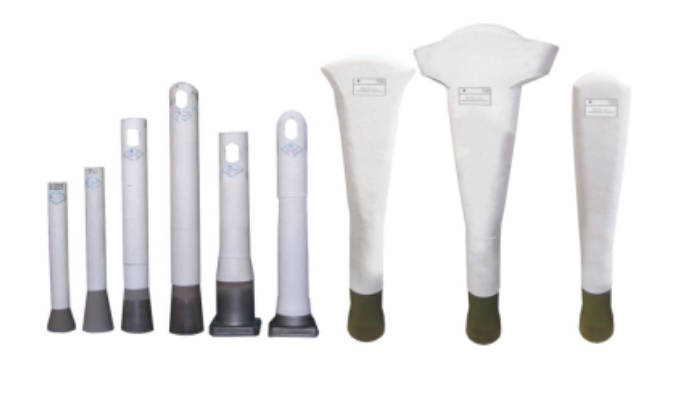
The development of continuous cast refractory products has introduced the isostatic pressing (CIP) molding process into the manufacturing of refractory materials. This is because:
(1) The length/diameter ratio of long nozzle bricks, immersed nozzle bricks and integral stopper rods is too large and cannot be pressed with ordinary double-sided hydraulic presses. Only by using isostatic pressure (CIP) can the pressure on the pressing surface be uniform. The volume density of each section of the brick is uniform.
(2) Isostatic pressing (CIP) can press corundum-graphite mud with high graphite content that is difficult to press and has low binder content and poor plasticity.
(3) Since long nozzle bricks, immersed nozzle bricks and integral plug rods are made of corundum-graphite material with high graphite content, only isostatic pressing (CIP) molding can avoid brick cracks and ensure brick quality.
. Tundish Metering Nozzle&Zirconia Inserts
What Is The Composition Of Sub Entry Nozzle(SEN)
Ladle Shroud Gasket – Material, Function, Shape & Installation Guide
How to Use the Ladle Shroud Manipulator in Continuous Casting Operations
Operation procedure of dry material for induction furnace
Drawing design method and skill of ladle slide gate plate
slide gate plate test report In AK Middletown 225-ton ladle